StudyNest
Founder · Full-Stack Engineer
A full-stack study partner matching and collaboration platform. Students find compatible partners, share notes, join live study sessions, video-call each other, and get AI study assistance.


- API endpoints
- 100+API endpoints
- Realtime events
- 100+Realtime events
- Data models
- 22Data models
- Passing tests
- 387Passing tests
- Match time
- < 1sMatch time
- Pilot satisfaction
- 86%Pilot satisfaction
- AI improved study
- 95%AI improved study
01 / 09
The problem
The idea began in my first weeks at university. I knew nobody. I wanted someone taking the same subjects, in the same year, who studied the way I did. Apps for messaging people were everywhere. None of them helped me find the right people.
After the remote learning period, many students ended up studying alone. Nothing brought together the three things they needed: finding a suitable study partner, a space to work with them, and help the moment a problem came up while studying. Those are the moments a student needs support.
That is where the name comes from. A nest is a bird's home: the place it is safe, grows up, and learns to fly. StudyNest is meant to be that for students, a place they live in while they study, with the people they study with, that feels like home. The logo says it too: a small bird resting in its nest under a graduation cap.
02 / 09
Three days to a working version
I started in June 2025, during a summer course, a week before midterms. The capstone was not due to begin for months. I started early on purpose, to build the project calmly instead of under the pressure of a full semester.
I wrote down three ideas, picked one, and had a working prototype three days later. I kept building on the same prototype for a full year, up to the final capstone evaluation. I presented the work there for the Information Technology Department, and entered the project into the London International Youth Science Forum.
- First prototype
- 3 days
- Started
- Jun 2025
03 / 09
Not another LMS
Moodle and Google Classroom were never the competition. They manage courses and organise teaching material, and they do the job well.
Neither one helps a student find people to study with, or work alongside them once found. StudyNest completes those platforms and adds the social, collaborative side they leave out.
04 / 09
Ranked, not filtered
A search box would have handed the work straight back to the student. Filter by subject, filter by year, and you are left looking at a hundred names with no idea which one to message.
So every other student is given a score against you, built from seven things: the subjects you share, your learning style, your university, where you are, the interests you share, your ages and your language. Shared subjects count for the most, because two people taking the same course have real work to share. Academic level is a filter you can switch on if you want it, and it deliberately counts for nothing in the score.
No model is involved in the number, and the reason matters more than the technique. A score has to be explainable to the student who reads one. "You share three of four subjects and you both revise the same way" is something a person acts on. A number a model produced explains nothing, two students with identical profiles might be given different scores, and nobody would be able to say why.
- Things scored
- 7
- Ranked results in
- < 1s
05 / 09
Somewhere to actually work
Putting two students in touch achieves nothing while they still have nowhere to go. So the match leads into a room: live chat, voice and video, screen sharing, and sessions somebody schedules in advance.
Rooms have a host, co-hosts and participants, and that is not administrative decoration. A study room stops working the moment a fifth person joins and nobody is able to mute anyone, remove anyone, or end the call. Someone needs the power to do so.
Most of the work went where nobody looks. When the host closes their laptop the room passes to the co-host who joined first, then to the earliest participant, and it closes only after everyone has gone. Every device reports in every fifteen seconds, and anyone who drops gets thirty seconds to come back into the same room rather than rejoining as a stranger.
- Realtime events
- 100+
- REST endpoints
- 100+
06 / 09
Help where the student is stuck
Gemini does two jobs in StudyNest: the study assistant, and reading a CV or LinkedIn export to fill in a profile. Matching never touches it.
The assistant has a name: Nour, نور, which means light in Arabic. That is its job: to guide students out of the dark, the confusion of being stuck, and into the light of understanding. It fits the app around it too: the home page is a campus at night lit by lamps, and the theme colour is called the lamp. The name reads the same in Arabic and English, and it introduces itself as your study buddy, not a tool.
Nour is a small character drawn in code, wearing the cap from the StudyNest logo with a lamp-coloured tassel. It blinks, its eyes follow your pointer on the welcome screen, it looks around while an answer is on the way, and it smiles when one lands. It is dark ink in light themes and white in dark ones, and it keeps still for anyone who turns motion off.
The assistant answers questions typed or spoken, reads the documents and images a student uploads, and explains what is in them. A course outline becomes a revision plan, or a set of flashcards.
Reading files rather than only questions matters because the missing thing was never information. A student stuck at eleven at night has the whole internet in front of them. What they lack is an answer about the page under their eyes, at the moment of looking.
07 / 09
Four places in Oman
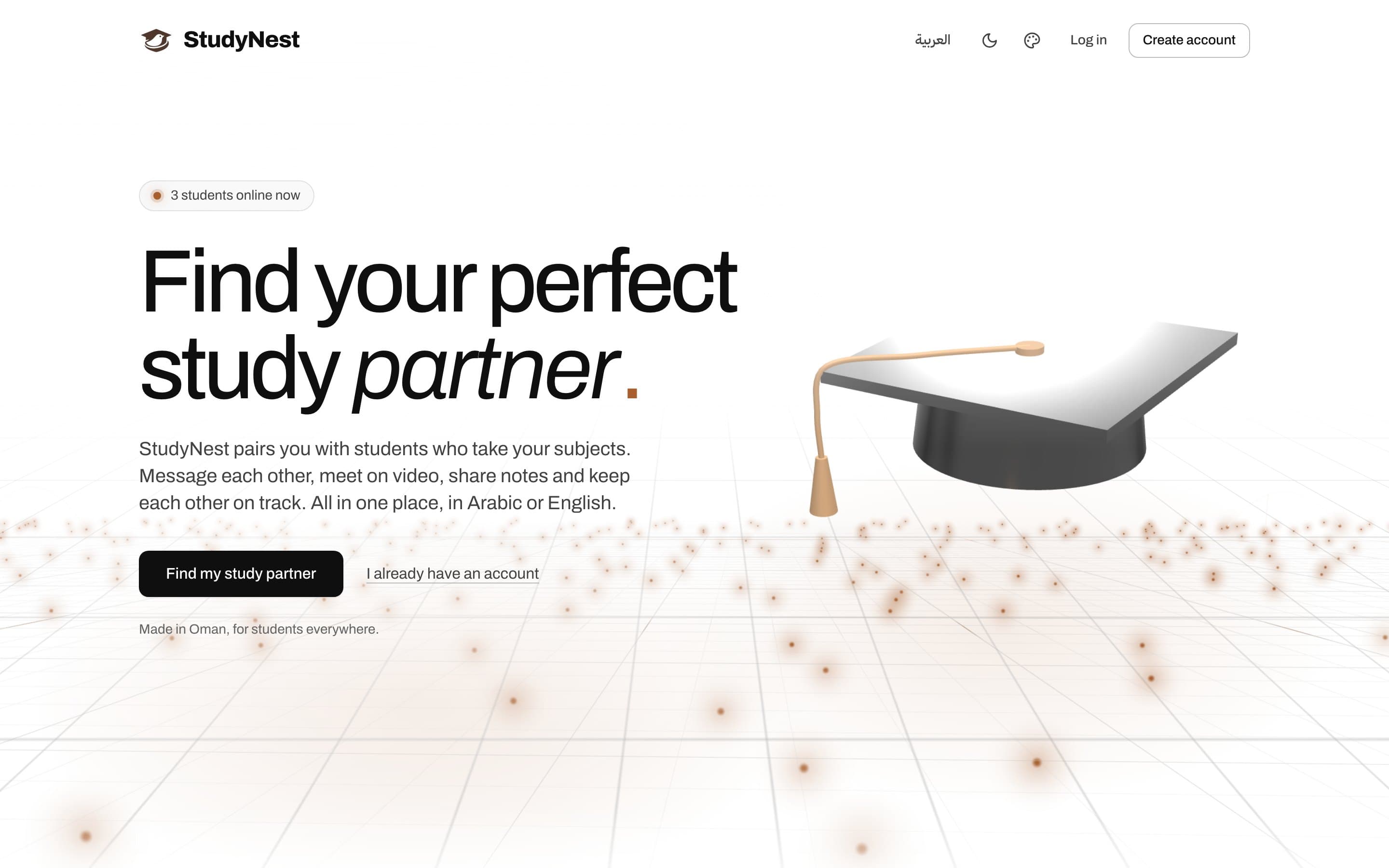
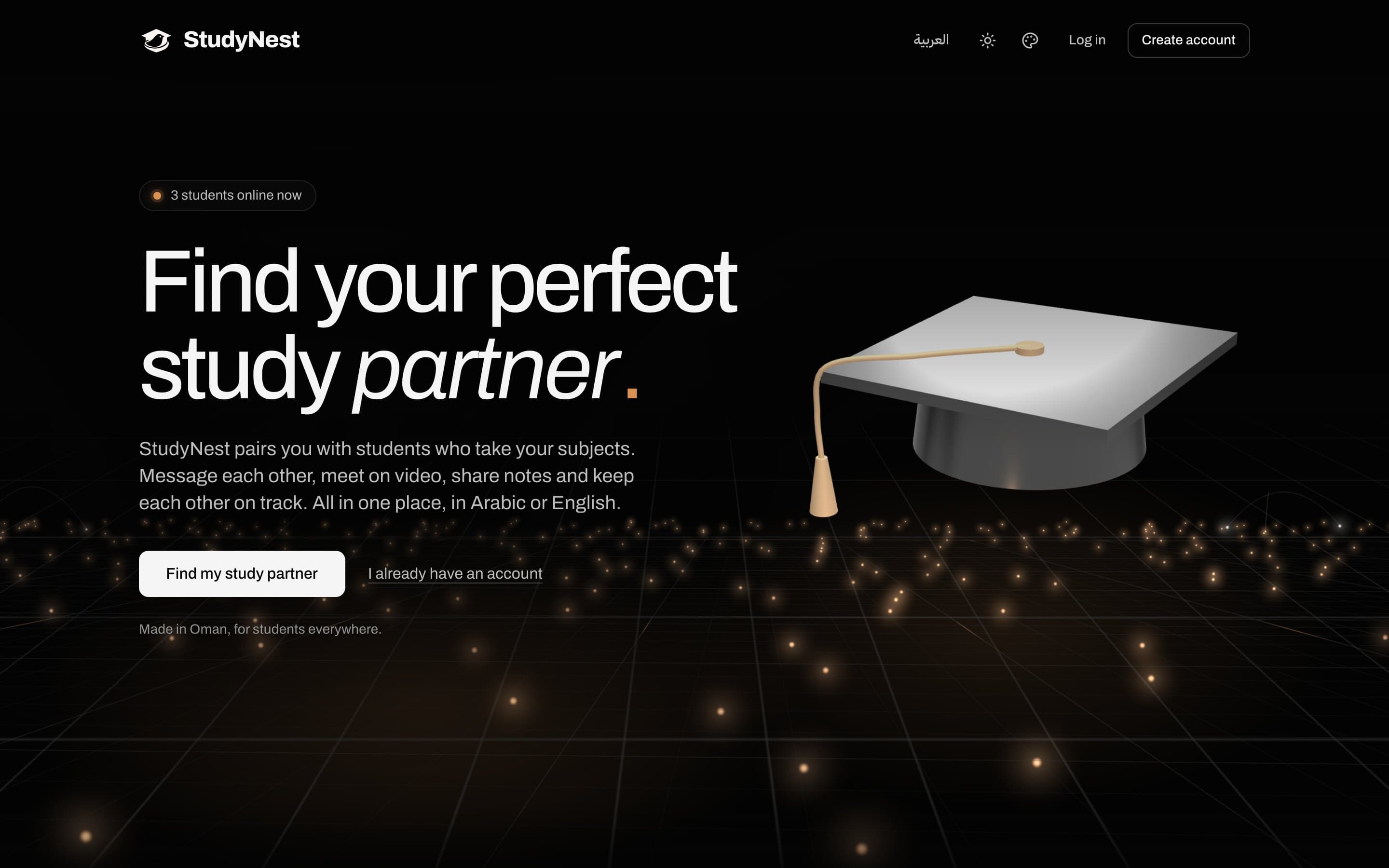
StudyNest is an Omani app, so its themes are Omani too. There are four colours, and each one comes in light and dark, so nobody has to give up a colour they love to get dark mode. Pick Auto and it follows your device. The app itself stays calm and black and white; each theme changes the background and one signature colour, and even the 3D campus on the home page turns into a night campus or a daylight one to match.
Nest Brown is StudyNest's own colour, the brown of the logo and the nest in the name. Muttrah Sea takes the navy and sea blue of the Muttrah corniche in Muscat, a harbour after sunset in dark mode. Khareef Green is Dhofar in the monsoon season: white with a breath of Salalah mist in light mode, deep green in dark. Jabal Rose is the damask rose of Jebel Akhdar, the Green Mountain: rose-white by day, deep plum at night.
Every one of the eight palettes is checked for contrast each time the app is built, so body text stays easy to read whichever place you choose.
- Colours
- 4
- Themes, light and dark
- 8
08 / 09
What a student account holds
A timetable. Coursework. Notes nobody else was meant to read. A phone number, and a face on a video call. The list is why the security work came first rather than after launch.
Signing in uses JWT, every refresh token is checked against the database before it is honoured, permissions follow the role someone holds in a room, and there is two-step sign-in and email confirmation. An access token lives fifteen minutes and a refresh token seven days, so a stolen one stays useful only briefly.
No account is ever deleted outright. The record is marked and left out of the checks enforcing uniqueness, so a student who leaves keeps the right to come back on the same email instead of losing the address forever. 387 tests cover the parts where a mistake costs something: 310 on the server, 14 of them on the scoring itself, and 77 on the frontend, across 22 data models.
- Passing tests
- 387
- Data models
- 22
09 / 09
What happened
Forty-four students used the platform during the pilot.
The surveys showed 86% were satisfied with the experience, while 95% said the AI assistant improved how they study.
The project was graded Distinction as a senior capstone, and selected among the top 30 of 738 projects nationally at the London International Youth Science Forum finals held in Muscat.
- Pilot students
- 44
- High satisfaction
- 86%